

|
|
|
|

In A Shipyard
|
WHEN BENT TO SHAPE
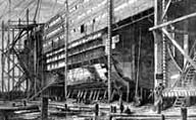
The outer skin of the hull is made up of a great number of steel plates riveted to the frames. The plates of a very large ship may weigh up to 4 tons each and be 40 feet long. They are arrangedin strakes, or courses, corresponding to the courses in a brick wall. Alternative strakes touch the frames and are overlapped along the edges by the immediate strakes. In order to fit snugly against certain parts of the framework, some of the plates have to be bent very exactly to shape, and every plate hasto have rivet holes punched in it to come exactly over holes in the framewrok or orther plates next to it. This means a great deal of measurement and marking. The frames are very deep over the flat part of the ship's bottom, and are covered with a plating inside as well as outside, thus forming what is called a double-bottom, which gives extra protectionto the part of the hull most likely to be damaged. The double-bottom can also be used for holding water ballast, fuel oil, etc. The decks are riveted to the deck beams and sides of the ship. The upright partitions, called bulkheads, divide the hull into a number of water-tight comparments, and both strengthen it and reduce the danger of sinking if the ship springs a leak or sustains damage to her plates. The framework, sides, bottom and decks of a ship give it great stiffness in all directions, and they are kept in their proper positions by the members of the framework. So much for the general arrangements of the hull's parts. A ship is built on a great flat floor of concrete or wood, called a slipway. This falls towards the water on a slope of about half-an- inch to the foot. Now, the hull of a big ship may weigh 15,000 tons to 20,000 tons when it is ready for launching. If the floor sank at any point during its construction, the results would be disastrous. So the whole areaof a slipway is made quite safe by driving thousands of piles into the ground. The tops of these carry great cross-timbers, which are covered with concrete or thick planks, forming an immovable floor. In a few instances a slipway is roofed over, though most slipways are open to the air. But whether closed in or open, a slipway is well provided with powerful cranes, commanding the whole of it, which lower plates and beams into the place where they are wanted andsupport them till they are fixed. The cranes come in useful also for suspendeding the riveters and their heavy tools.
|